
The English Language Arts Curriculum reminds us that story and texts can be a source of joy and creativity that helps us learn and be curious about ourselves and the world around us.
To teach reading, it is important to understand the foundational skills and how they work together to create strong, rich and reliable readers.
Click on each skill to see strategies and tools that NLPS teachers are using.
Note: Skilled readers interconnect the individual foundational skills. To learn more about Scarborough’s Rope, click here.
Concepts of Print
Understanding that written language represents meaningful oral language and that books and print have structure.
Book Parts: Title, cover, author, spine orientation, etc.
Directionality: Book handling, left to right, top to bottom, etc.
Text Features: Page numbers, punctuation, diagrams, etc.
Print Structure: Visual boundaries of letter, word, and sentence; 1:1 oral / written word correspondence
Heggerty – Check with your IST to access the school copy or check with your librarian to see if there is a copy in the district collection.
Phonemique – A phonemic awareness program written by Canadian French Immersion teachers. To preview a copy from the district collection, click here.
Les Alphas – This playful, story-based program serves as a foundation to phonological awareness and phonics instruction in French Immersion classes. To preview a copy from the district collection, click here.
Heggerty – Check with your IST to access the school copy or check with your librarian to see if there is a copy in the district collection.
Phonemique – A phonemic awareness program written by Canadian French Immersion teachers. To preview a copy from the district collection, click here.
Les Alphas – This playful, story-based program serves as a foundation to phonological awareness and phonics instruction in French Immersion classes. To preview a copy from the district collection, click here.
Heggerty – Check with your IST to access the school copy or check with your librarian to see if there is a copy in the district collection.
Phonemique – A phonemic awareness program written by Canadian French Immersion teachers. To preview a copy from the district collection, click here.
Les Alphas – This playful, story-based program serves as a foundation to phonological awareness and phonics instruction in French Immersion classes. To preview a copy from the district collection, click here.
Heggerty – Check with your IST to access the school copy or check with your librarian to see if there is a copy in the district collection.
Phonemique – A phonemic awareness program written by Canadian French Immersion teachers. To preview a copy from the district collection, click here.
Les Alphas – This playful, story-based program serves as a foundation to phonological awareness and phonics instruction in French Immersion classes. To preview a copy from the district collection, click here.
Decoding is using knowledge of letters and sounds and spelling patterns to solve words. It is important because building automaticity with familiar spelling patterns helps to solve new words.
Teach complex and irregular phonics patterns such as complex long vowels, diphthongs, vowel-r, -le, silent consonants, multisyllabic words etc, in a systematic way.
To learn more about Phonics and Decoding, check out the Reading Universe.
Decoding is using knowledge of letters and sounds and spelling patterns to solve words. It is important because building automaticity with familiar spelling patterns helps to solve new words.
Teach regular phonics patterns such as CVC, digraphs, blends, two syllable words with short vowels etc, in a systematic way.
To learn more about Phonics and Decoding, check out the Reading Universe.
In English, there are 26 letters that make 44 sounds (phonemes). The sounds of spoken language are respresented by letters and spelling patterns called graphemes.
To learn more about the Alphabetic Principle, check out the Reading Universe.
Phonics programs help readers understand the relationship between letters-sounds, while supporting teachers to introduce letters and sounds in a systematic order. Consider starting with letters that are used most frequently such as s, a, t, p, i, n.
Try:
Les Alphas – To preview a copy from the district collection, click here.
Be sure to practice new letters, while reviewing previously taught letter by practicing familiar letters-sounds in words and names that are familiar to the students.
Should I teach similar letters together or separately?
Letters such as b and d can be visually and auditorily confusing. Try to solidify the understanding of one before introducing the second. Teaching similar letters at the same time can contribute to confusion.
Starting with two (or more) consonant sounds with a singel vowel sound within a lesson to beginning building words. Eg: t-p-n-a
Where can I access free E-books and Audiobooks for students?
Measuring rate is counting the number of words a child can read per minute. Rate measures the automaticity of a child’s word solving skills.
A high rate of word solving is one of many skills required of readers and must be developed in partnership with other reading skills. Skilled readers must also be able to read with expression that aligns with punctuation and comprehend the text they are reading.
How fast is too fast?
A child should strive to read at a rate similar to their pace of conversation to allow for comprehension and time to think.
What does it tell me if a child reads slowly?
It is important to first monitor the child’s ease of word solving and the child’s level of comprehension. Reading slowly may be a reminder to practice the automaticy of decoding skills.
For further reading, click here.
Irregular high frequency words are common words that don’t follow typical spelling patterns (non-decodable).
Irregular words can be generalized into two categeories:
Where can I access free E-books and Audiobooks for students?
Syntax refers to the set of rules and principles that govern the structure of sentences in a language. It specifies how words and phrases should be arranged to form meaningful and grammatically correct sentences. Syntax encompasses various elements such as word order, sentence structure, punctuation, and the use of grammatical markers such as tense, aspect, and agreement. A mastery of syntax is essential for effective communication in any language.
Read and analyze sentences: Encourage students to read different types of texts and analyze the structure of sentences. Ask them to identify the subject, verb, and object in the sentence, and how they are related to each other.
Use visual aids: Visual aids such as diagrams, charts, and graphic organizers can be used to help students understand sentence structure and how words are arranged to convey meaning.
Practice sentence construction: Provide students with opportunities to practice constructing sentences using different sentence structures and grammatical rules.
Model good sentence structure: Model good sentence structure in your own writing and speech. Point out examples of good syntax in literature and everyday language.
Provide feedback: Provide feedback to students on their writing and speech, focusing on sentence structure and grammar. Encourage students to revise their work to improve their syntax.
Make it fun: Incorporate games, puzzles, and other engaging activities to make syntax practice more enjoyable and memorable for students.
Books by Brian B Cleary: https://www.brianpcleary.com/
15 picture books that teach grammar:
https://learningattheprimarypond.com/blog/15-picture-books-for-teaching-grammar-and-conventions/
Online Grammar Game: https://www.funbrain.com/search?q=grammar
Reading vocabulary refers to the words that a person is able to recognize and understand when reading a written text. It includes both the words that the person knows the meanings of and can use in their own writing and speech, as well as words that they may recognize but not necessarily be able to use correctly in context. Reading vocabulary is important for comprehension and communication, and it typically expands as a person reads more and encounters new words and concepts.
Explicit Vocabulary Instruction: Teachers can explicitly teach new words to students, including their definitions, pronunciation, and how they are used in context. This can be done through direct instruction, using vocabulary lists, or by highlighting key words in texts and discussing their meanings.
Contextual Clues: Teachers can encourage students to use contextual clues to determine the meaning of unfamiliar words. This involves looking at the words and sentences around the unknown word to make an educated guess about its meaning.
Wide Reading: Teachers can encourage students to read widely and often, which exposes them to a variety of new words and concepts. Encouraging students to read a variety of genres, including fiction and non-fiction, can also help to expand their vocabulary.
Vocabulary Games and Activities: Teachers can use games and activities, such as word puzzles, vocabulary bingo, and vocabulary charades, to make learning new words more engaging and fun for students.
Word Walls: Teachers can create a word wall in the classroom, which is a display of key vocabulary words that students are learning. This can help students to see and use new words in context, and can also serve as a visual reminder of the vocabulary they are learning.
Expressive oral vocabulary refers to the words that a person is able to use and communicate verbally, meaning they can actively use these words when speaking.
Receptive oral vocabulary, on the other hand, refers to the words that a person is able to understand when they hear them being used verbally, meaning they can comprehend and understand these words when they are spoken to them.
Expressive Oral Vocabulary:
Encourage students to use new words in their speech and writing.
Model the use of new vocabulary words during instruction and conversations.
Use word games and activities such as charades, Pictionary, or taboo to make learning new words fun and engaging.
Provide opportunities for students to use new words in context, such as through discussions or debates.
Encourage students to read widely, as exposure to new words in context can help with vocabulary development.
Receptive Oral Vocabulary:
Use visuals such as pictures, videos, or diagrams to support understanding of new vocabulary words.
Use explicit instruction to explain the meaning of new words and provide multiple examples of how they can be used.
Encourage students to ask questions when they encounter new vocabulary words.
Provide opportunities for students to hear and use new words in context, such as through read-alouds or classroom discussions.
Encourage students to engage in independent reading to build their vocabulary and understanding of new words.
Wordless picture books are a valuable resource for developing both expressive and receptive oral vocabulary in students. These books provide a visual narrative that allows students to create their own stories and share their ideas, which promotes expressive oral language development. In addition, wordless picture books offer opportunities for students to learn new vocabulary words through context, visual cues, and discussion, which supports receptive oral language development. By engaging students in a variety of activities such as storytelling, sequencing, predicting, describing, and group discussion, teachers can help students to expand their vocabulary knowledge, improve their communication skills, and become more confident and effective oral language users.
Using Wordless Picture Books
Structured Word Inquiry
Teachers can use SWI strategies to support vocabulary development in their students by:
Breaking down new vocabulary words into their constituent parts and examining their meaning and use.
Encouraging students to think critically about how words are formed and how they are used in different contexts.
Using visual aids such as word webs and diagrams to help students better understand the structure of words.
Providing opportunities for students to use SWI strategies independently, such as through word sorts and word hunts.
Wordless Picture Books
Wordless picture books are a valuable resource for developing both expressive and receptive oral vocabulary in students. These books provide a visual narrative that allows students to create their own stories and share their ideas, which promotes expressive oral language development. In addition, wordless picture books offer opportunities for students to learn new vocabulary words through context, visual cues, and discussion, which supports receptive oral language development. By engaging students in a variety of activities such as storytelling, sequencing, predicting, describing, and group discussion, teachers can help students to expand their vocabulary knowledge, improve their communication skills, and become more confident and effective oral language users.
https://clpe.org.uk/system/files/Wordless%20books%202021.pdf
Lorem ipsum dolor sit amet, consectetur adipiscing elit. Ut elit tellus, luctus nec ullamcorper mattis, pulvinar dapibus leo.
Literature Circles (sometimes called Book Club) is a wonderful way for the advancing reader to gain independent reading skills and explore text extensions by discussing literary elements such as questioning, identifying themes and connections (Text to Text, Text to Self, Text to World). This method of learning lends itself well to differentiation and enables the teacher to work with a small group for instruction.
Shared Reading is when students and the teacher read aloud an enlarged version of text together in unison or in turns. This provides the teacher the opportunity to model fluent reading and word solving. Try this approach in Socials or Science to cooperatively solve new words or think beyond the text.
Concrete understanding involves the grasp of both the explicit (literal) and implied (propositional) meanings derived from a text. Additionally, it encompasses the skill of organizing and comprehending the sequence of events presented within the text.
Zoom-In
Closely look at a portion of an image that is revealed
Active and purposeful understanding of the content, form and spoken language.
Listening comprehension is an important part of reading comprehension. Decades of research confirm that listening comprehension outpaces reading comprehension from early childhood through at least middle school.
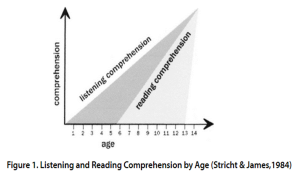
Reading aloud is the single most important activity for reading success (Bredekamp, Copple, & Neuman, 2000). Children can listen on a higher language level than they can read, so reading aloud makes complex ideas more accessible and exposes children to vocabulary and language patterns that are not part of everyday speech.